The NGO RAPAA and the NGO FAMME: an action of sensitization and voluntary HIV testing for students and vulnerable women
- Posted on 19/12/2022 15:26
- Film
- By raymonddzakpata@sante-education.tg
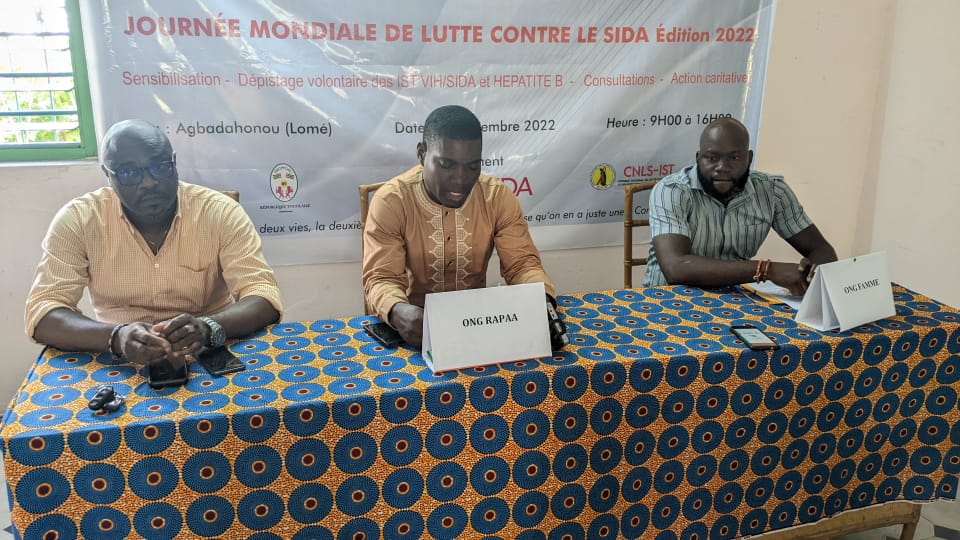
Extract from the article: As part of the celebration of the World AIDS Day observed every 1st December, the NGO RAPAA and the NGO FAMME organised a meeting with media professionals on Thursday 15th December 2022 in Lomé. The aim of this meeting was to inform the media about..
As part of the celebration of the
World AIDS Day observed every 1st December, the NGO RAPAA and the NGO FAMME
organised a meeting with media professionals on Thursday 15th December 2022 in
Lomé. The aim of this meeting was to inform the media about the actions carried
out and the results obtained during the two (02) days of activities.
Since 2015, the NGO RAPAA has
used the World AIDS Day as an opportunity to carry out actions to fight against
the use of psychoactive substances and HIV/AIDS contamination. For the 2022
edition of World AIDS Day, the Joint United Nations Programme on HIV/AIDS
(UNAIDS) wanted to focus on eradicating the inequalities that fuel the AIDS
epidemic and hinder progress through the theme: "Pushing for
equality". With this in mind, the NGO RAPAA, in collaboration with the NGO
Force en Action pour le Mieux-être de la Mère et de l'Enfant (FAMME), an
organisation that has been working for many years with women in vulnerable
situations, conducted awareness-raising activities and voluntary testing for
STIs, HIV/AIDS and hepatitis B. These actions, which were perfectly integrated
into the global theme of the WDD, were carried out thanks to the technical
support of the National Council for the Fight against AIDS (CNLS) and the
financial support of UNAIDS.
Development
of the two days of activities
On Friday 09 December 2022, the
teams of the NGO RAPAA and the NGO FAMME in collaboration with the peer
educators carried out information, sensitisation, voluntary screening for STIs
HIV/AIDS and hepatitis B, therapeutic consultations for the students of the
university ESIG GLOBAL. The NGO RAPAA has already intervened in this university
and sensitized students on two important themes such as "Consumption of
psychoactive substances and risky sexual practices" and "Consumption
of psychoactive substances and contamination with HIV/AIDS, hepatitis and
others". Then, on Wednesday 14 December 2022, teams from the NGO RAPAA and
the NGO FAMME joined sex workers and female porters at the public site of
Agbadahonou for information, awareness raising, voluntary screening for STIs
HIV/AIDS and hepatitis B, therapeutic consultations and the distribution of
hygiene materials.
Results of
the two days of activities
Under the influence of
substances, there is a greater risk of being exposed to risky sexual practices
such as unprotected sex, non-consensual sex and vulnerability to sexual
assault. Thus, for the two (02) days of activities, the intervention teams were
able to raise awareness among 255 students and 190 women and men on the
consequences of substance abuse, particularly the risks of contamination with
STIs, HIV/AIDS and hepatitis B. To reinforce these awareness-raising activities
and reduce the risks of contamination by STIs/HIV/AIDS, prevention tools such
as 810 leaflets, posters and stickers were distributed to participants, and
around 10,000 male condoms, 1,500 female condoms and 2,250 lubricants were
distributed to encourage women to have protected sexual relations.
During these days of activities,
nearly 183 students, 83 of whom were girls and 100 boys, were able to undergo
voluntary HIV testing, and 102 people, 55 of whom were women and 47 men, most
of whom were drug users, underwent voluntary testing for HIV, Hepatitis B and
STIs. The positive cases detected were referred to the medical and social
centre of the NGO FAMME, which specialises in the care of people living with
HIV.
It is important to reduce
socio-economic inequalities and to strengthen actions aimed at people with
difficult living conditions in order to avoid their stigmatisation and
marginalisation, with all the risks inherent in their social exclusion.
Raymond
Dzakpata