Media and civil society players briefed on the results of the STEPS 2021 survey
- Posted on 23/11/2024 18:09
- Film
- By abelozih@sante-education.tg
Extract from the article: On 22 and 23 November in Kpalimé, the Ministry of Health and Public Hygiene, through the Non-Communicable Diseases Surveillance Division, presented the results of the STEPS 2021 survey on risk factors for non-communicable diseases (NCDs). This was do
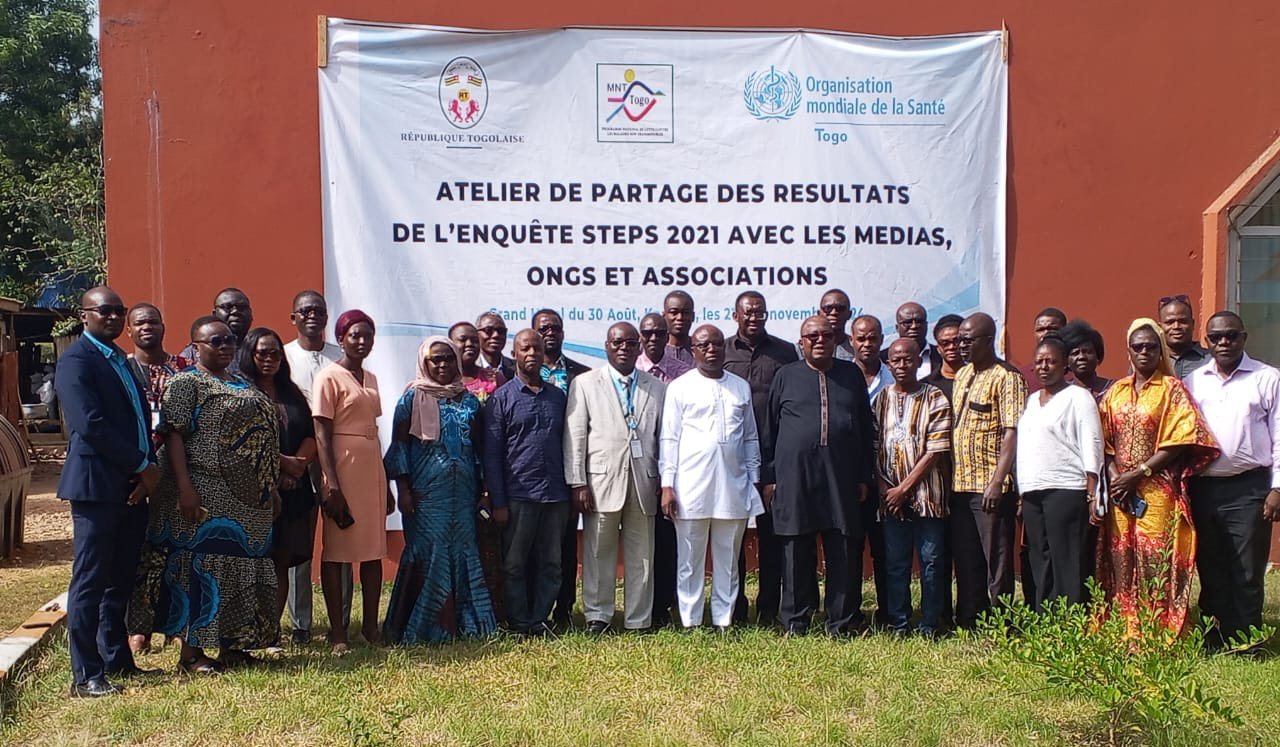
On 22 and 23 November in Kpalimé, the Ministry of Health and Public Hygiene, through the Non-Communicable Diseases Surveillance Division, presented the results of the STEPS 2021 survey on risk factors for non-communicable diseases (NCDs). This was done during a briefing workshop for the media, NGOs and associations. The survey, which will run from 6 December 2021 to 21 February 2022, has been carried out with financial support from the WHO.
This is the
second national survey of risk factors for non-communicable diseases in Togo.
The ‘STEPwise’ approach recommended by the WHO was the methodology used from
the planning phase through to dissemination of the results. The survey provides
Togo's entire health system with basic factual indicators on the risk factors
for the main non-communicable diseases and the initial population trends on
which the various programmes to combat them can base their policies and
strategies.
For
Professor Mofou Belo, Head of the Non-Communicable Diseases Surveillance
Division at the Ministry of Health, and National Coordinator of the STEPS Togo
2021 survey, this is one whose methodology uses StepWise strategies put in place by the World Health
Organisation to help all countries take stock of certain health issues, in
particular non-communicable diseases, and to use the results to put in place
action plans to reorient or change paradigms in terms of managing health
problems.
NCDs
are a problem
The
STEPS Togo 2021 survey has once again confirmed that non-communicable diseases
are a major public health challenge in Togo. The prevalence of high blood
pressure, the main risk factor for strokes and heart attacks, had risen from
19% in 2010 to 27.4% in 2021, while the prevalence of diabetes, estimated at
2.6% in 2010, had risen to 4.9% in 2021 in the adult Togolese population. The
prevalence of smoking, one of the greatest threats to public health, was 5.0%.
The survey also revealed that more than eight out of 10 people in Togo consume
fewer than the five portions of fruit and vegetables per day recommended by the
WHO. It also revealed that the Togolese population consumed an average of 9.3
grams of salt a day.Similarly, 7 out of 10 people did not know their blood
sugar status (77.4%) and 3 out of 10 had never measured their blood pressure
(36.6%).The STEPS survey also revealed a lack of access to treatment for
hypertension and diabetes.Among people with hypertension (known and unknown),
78.7% were not taking antihypertensive medication.Among known diabetics, only
58.0% were on oral anti-diabetic treatment and 18.9% were on insulin-based
treatment at the time of the survey.
«There
are so many challenges to be met, especially hypertension (high blood pressure)
and diabetes, which are silent killers.The results of this survey showed that
27% of the population aged between 18 and 64 have high blood pressure, or a
quarter of the Togolese population.In terms of diabetes, we found that 5% of
the Togolese population in this age group have diabetes.Most of these people do
not know they have diabetes.Those who do know they are diabetic either don't
manage to take the medication or don't have access to it.It's a real
scourge.Today, we are also one of the countries in Africa where smoking is
reduced to a very low level», stresses Pr Mofou Belo,
National Coordinator of the STEPS Togo 2021 survey.
The
risk factors for the appearance of the main non-communicable diseases were
found in almost all social groups and especially in vulnerable groups, such as
pensioners, the elderly, people with a low level of education, young people and
women of childbearing age.
«We
need to step up our awareness campaigns to help people change their
behaviour.We must encourage and support the media in conveying information
about these non-communicable diseases, which are linked to our behaviour»,
insists Pr Mofou Belo.
There
is therefore an urgent need for Togo to step up the momentum it began building
in 2011 to prevent and combat non-communicable diseases.
William
O.